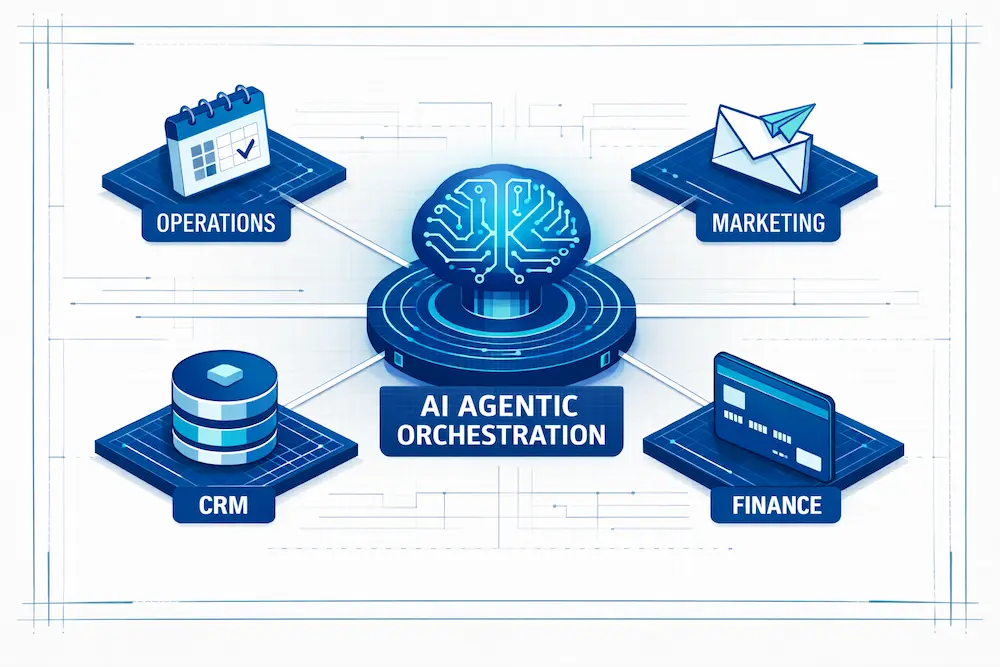
The 2026 Guide to Agentic Workflows
The “AI honeymoon” is over. In 2024 and 2025, businesses were fascinated by chatbots that could summarize emails or write catchy captions. But as we move through 2026, the novelty of “chatting” has faded, replaced by a much more powerful necessity: execution.
Enter Agentic Workflows. We are shifting from a world of Generative AI (which creates content) to Agentic AI (which performs work). If you are still manually copying and pasting data between ChatGPT and your CRM, you aren’t just behind the curve—you are leaving hundreds of billable hours on the table.
What is an Agentic Workflow?
An Agentic Workflow is an autonomous system where AI “agents” use reasoning to complete multi-step business processes without constant human prompting. Unlike traditional automation (which follows rigid “if-this-then-that” rules), Agentic AI can plan, use digital tools, and correct its own errors to reach a goal.
The 2026 Shift: Chatbots vs. Autonomous Agents
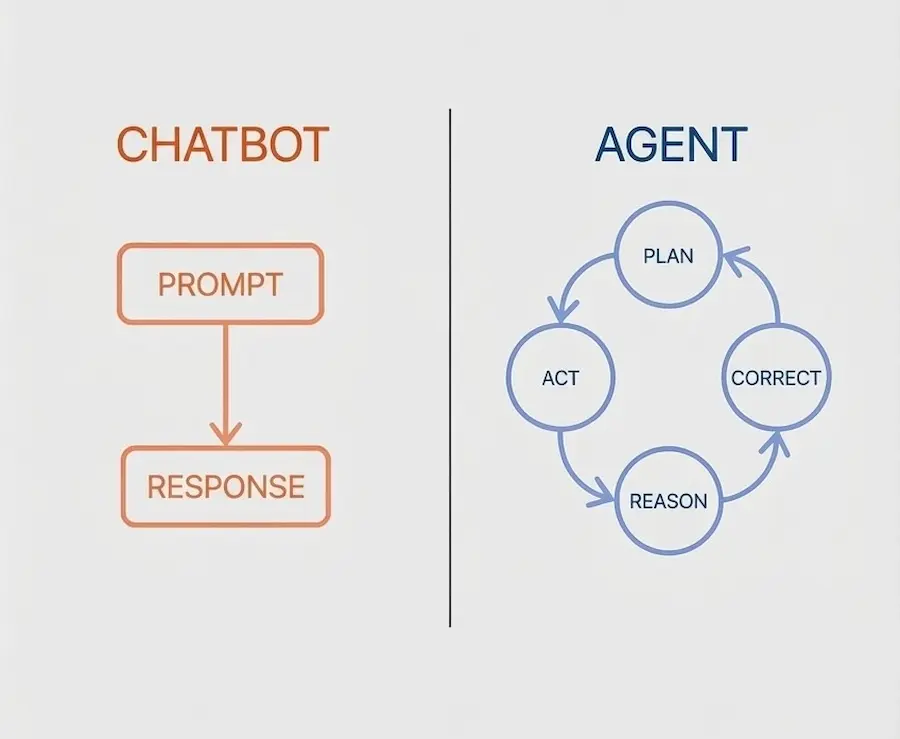
To understand why this matters for your business, we have to look at the “Reasoning Gap.” Traditional automation is a straight line; Agentic AI is a loop.
| Feature | Legacy Chatbots (2024) | Agentic workflows (2026) |
|---|---|---|
| User Interaction | One prompt = One answer. | One goal = Many actions. |
| Logic Model | Pattern matching. | Chain-of-Thought (CoT) reasoning. |
| Tool Access | Read-only (mostly). | Full “Read/Write” via Model Context Protocol (MCP). |
| Error Handling | Fails if the input is slightly off. | Self-corrects and retries different paths. |
Technical Foundations:
To understand the current state of software, we must look at the “Infrastructure of Agency.” In 2026, the breakthrough isn’t just “smarter” models, but Model Context Protocol (MCP). This allows an AI agent to securely “plug in” to your business data—be it a SQL database, a Slack channel, or a specialized CRM—without needing custom, fragile API integrations for every single task.
However, autonomy comes with a price tag: Inference Costs. Unlike old-school software with a flat monthly fee, Agentic AI costs money every time it “thinks.” Strategic business owners in 2026 are optimizing their workflows to balance model “intelligence” with token efficiency.
3 High-Impact Use Cases: From Theory to Profit
Here are three ways agents are actually being deployed right now.
1. The Autonomous Sales Prospector
In the past, sales required a human to find a lead, research their company, and write a personalized note. An agentic workflow handles this entire chain.
-
The Workflow: The agent identifies “warm” leads —-> uses Retrieval-Augmented Generation (RAG) to scan their recent financial reports —-> drafts a hyper-specific outreach —->pings the human only when a meeting is booked.
-
The ROI: A $75%$ reduction in “busy work” for sales teams.
2. The 24/7 “Triage” Operations Manager
Customer service has evolved beyond the “FAQ bot.” Agentic workflows have “agency.” If a customer emails about a late shipment, the agent connects to the shipping API, identifies the delay, and calculates a discount based on the customer’s lifetime value ($LTV$).
-
The Formula: Discount = (LTV x 0.05) + Base Delay Credit.
-
It applies the credit and updates the CRM before a human even opens their laptop.
3. The Multi-Agent Marketing Loop
Marketing in 2026 is about “Micro-Relevance.” You don’t just have one AI; you have an orchestration.
-
Agent A (The Researcher): Monitors trending industry topics.
-
Agent B (The Creator): Generates a content brief and drafts the copy.
-
Agent C (The Critic): Fact-checks the copy and ensures it matches your brand voice.
-
The Result: High-quality content that ranks because it provides actual “Information Gain” rather than AI-generated fluff.
The “Human-in-the-Loop” (HITL) Framework
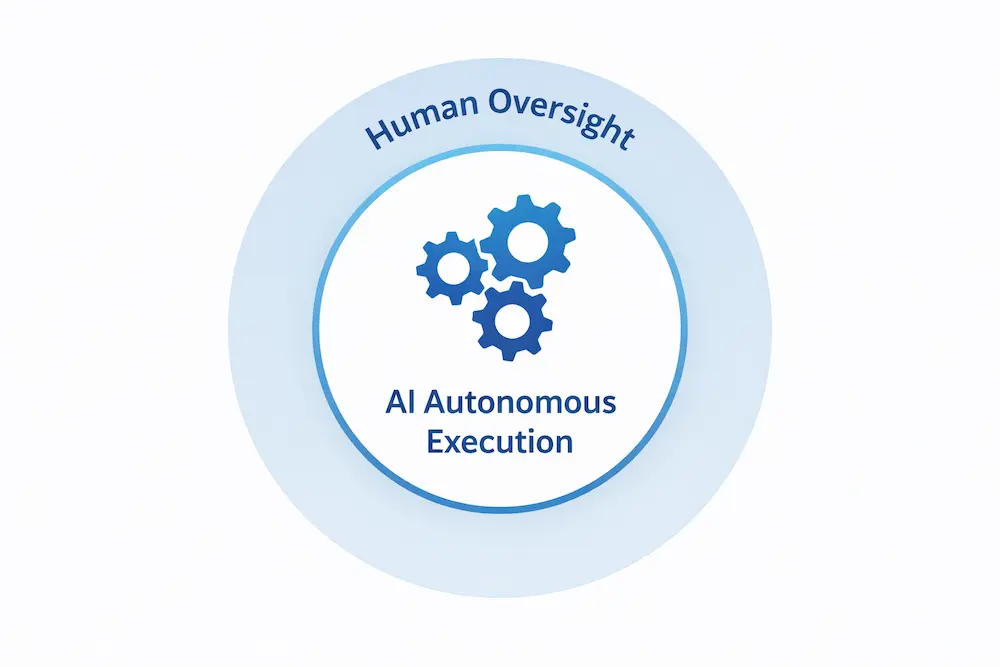
The biggest mistake SMBs make in 2026 is assuming “autonomous” means “unsupervised.” To maintain E-E-A-T (Experience, Expertise, Authoritativeness, Trustworthiness), you must implement a governance layer.
I recommend the “Sandwich Strategy”:
-
Human Input: You define the goal (e.g., “Increase conversion on the landing page”).
-
Agentic Execution: The AI agents perform the A/B testing, data analysis, and draft variations.
-
Human Review: You perform the final “sanity check” to ensure the brand’s soul isn’t lost in the automation.
For a concrete example of how much risk an agent can add when it runs on your own machine, see our guide to whether OpenClaw is safe for business.
Choosing Your 2026 Agentic Stack
When evaluating tools for your business, ignore the marketing hype and look for three things: Interoperability, Privacy, and Scalability.
-
For Orchestration: Look at platforms that support multi-agent systems. The ability for one agent to “supervise” another is the key to reducing AI hallucinations.
-
For Data Sovereignty: If you handle sensitive client data, look for “Local-first” or “Private-Cloud” AI options. In 2026, privacy is a competitive advantage.
-
For Connectivity: Ensure the tool supports Standardized Tool Calling. If an AI can’t “use” your other software, it’s just a fancy typewriter.
Your 90-Day Roadmap to Autonomy
If you feel overwhelmed, don’t try to automate your entire business in a weekend.
-
Days 1-30 (The Audit): Identify one task that takes you 5+ hours a week and is “process-heavy.”
-
Days 31-60 (The Pilot): Build a single-agent workflow using a no-code agent builder. If you know how to code, you can either use a no-code builder or choose to build it through coding; it’s up to you. Focus on “Read” tasks (researching and summarizing).
-
Days 61-90 (The Scale): Introduce “Write” permissions (sending emails, updating databases) once you have verified the agent’s logic for 30 consecutive days.
Conclusion: The Competitive Edge of 2026
The gap between the “tech-enabled” business and the “legacy” business is widening at an exponential rate. In 2026, the competitive advantage isn’t having AI—everyone has AI. The advantage is orchestration.
By moving beyond the chatbot and building agentic workflows, you aren’t just saving time; you are building a “Sovereign Business” that scales without the traditional overhead of massive headcounts. The future doesn’t belong to the person with the most tools, but to the one who knows how to make them work together.
3 Comments
Comments are closed.